
Phillis Wheatley Peters and the Black Congregational Calvinist Tradition
How might we theologically situate Phillis Wheatley Peters within the Black Congregational tradition?
In honor of the 250th anniversary of the publication of Phillis Wheatley Peters’ Poems on Various Subjects, Religious and Moral, we were pleased to host an important discussion of Wheatley Peters as a theological thinker within the Black Congregational Calvinist tradition with Steven Harris, Rev. Dr. Stephen G. Ray Jr., and Dr. Cassander L. Smith.
Wheatley Peters has rightfully garnered popular and academic interest for her work as a Black poet writing in eighteenth-century Boston. Kidnapped from West Africa and sold into enslavement as a young child, Wheatley Peters learned to read and write, and soon produced highly esteemed poems for members of her community. On September 1, 1773, her first book of poetry, Poems on Various Subjects, Religious and Moral, was published in London while on a trip with the son of the family that enslaved her.
Curiously absent from consideration, however, has been exploration of Wheatley Peters’ contribution to Black theology. Wheatley Peters sits uncomfortably in the narrative arc often told about Black theology, especially the Calvinist tradition she participated in as a member of Old South Church in Boston. Putting Wheatley Peters into conversation with other Black Congregationalists in the Calvinist tradition, such as Jupiter Hammon and Lemuel Haynes, reveals in important and interesting ways how she both adopted and adapted the theological material and resources available to her to make sense of her identity and social location.
LINKS TO RESOURCES RELATED TO THIS VIDEO:
- Research Guide: Black & Indigenous History in the Congregational Library & Archives’ Collections
- New England’s Hidden Histories
- Religion of Revolution Digital Exhibition
- Exploring Black Congregational Christian History YouTube Playlist
- Dr. Tara Bynum Speaking About Her Book, Reading Pleasures: Everyday Black Living in Early America
Do you have a question about materials in our collection at 14 Beacon? Get in touch anytime at ref@14beacon.org.
OCTOBER 19, 2023
KYLE ROBERTS: Good afternoon. My name is Kyle Roberts, and I’m the Executive Director of the Congregational Library & Archives. Welcome to today’s virtual discussion on Phillis Wheatley Peters and the Black Congregational Calvinist Tradition.
To begin, I’d like to acknowledge that the CLA resides in what is now known as Boston, which is in the place of the Blue Hills, the homeland of the Massachusett people, whose relationships and connections with the land continue to this day and into the future.
For those joining us for the first time, the Congregational Library & Archives is an independent research library. Established in 1853, the CLA’s mission is to foster a deeper understanding of the spiritual, intellectual, cultural, and civic dimensions of the Congregational story and its ongoing relevance in the 21st century. We do this through free access to our research library of 225,000 books, pamphlets, periodicals, and manuscripts, and our digital archive with more than 100,000 images, many drawn from our New England’s Hidden Histories project.
Throughout the year, we offer educational programs and research fellowships for students, scholars, churches, and anyone interested in Congregationalism’s influence on the American story. Please check our website, congregationallibrary.org, to learn more about what we do and for news of forthcoming events.
Now, our program today is in honor of the 250th anniversary of the printing of Poems on Various Subjects Religious and Moral by Phillis Wheatley Peters.
Wheatley was enslaved and brought to Boston from Africa at the age of seven in 1761. Susanna Wheatley, wife of a prominent Boston figure, John Wheatley, purchased a, “slender, frail female child for a trifle.” She was named after the ship that she had been carried over on. Phillis learned to read and write, and in August 1771, ten years after her arrival in Boston, she joined Old South Church, a leading Congregational church in the city.
Susanna Wheatley tried to convince Bostonians to support the printing of a volume of 28 of Phillis’ poems in 1772, but was unsuccessful. So they turned to London, where the book was published on September 1, 1773.
This landmark book of poetry has had an auspicious history over the following 250 years as a cornerstone of American poetry.
One fact that we are very fascinated by here in Boston is that crates with copies of that London printing were on one of the three ships, which were ransacked in the Boston Tea Party on December 16, 1773. Fortunately for us, it was the tea that was tossed overboard and not Wheatley’s volumes.
Now, the Congregational Library does not have an original copy of her 1773 London edition. If anybody out there has one that they’re interested in donating, we would love to have it.
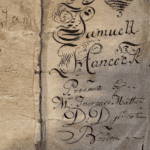
We do, however, steward the records of Old South Church, where you can see the record of her admission, and that’s the image up on your screen. “Phillis, servant to Dr… to Mr. Wheatley, August 18, 1771.”
And so we are just very happy to present today’s program on this leading 18th century Congregational poet. And as you’re gonna… as I hope you come away from this program, theological thinker.
Our presentation will start today with Mr. Steven Harris, and then turn to Dr. Cassie Smith, and Rev. Dr. Stephen Ray, Jr. for their responses. Following that, we’ll turn to a roundtable conversation. I’m just gonna go ahead for ease of flow and introduce all three of our speakers now.
Our first presenter, Steven Harris, is a public… is a faith based public policy expert and scholar of American religious history and African American Studies. He currently serves as Senior Director of Academic Programs at the Center on Faith and Justice at Georgetown University. Prior to arriving at Georgetown, Steven spent several years on Capitol Hill building coalitions and working on domestic and international public policy issues at the intersection of religion, justice, and human dignity. His research interests lie at the historical interpretation… intersection of Black religious thought and Calvinist theology. His most recent published writing on the topic was a contribution to the edited volume, “The Oxford Handbook of Calvin and Calvinism,” which came out from OUP Press in 2021. A Vanderbilt graduate, Steven received an MDiv from Southern Baptist Theological Seminary, an MA in Religion from Yale Divinity School, an MA in Religion from Harvard University, and is currently a PhD candidate at Harvard.
Our second discussant, Cassander Cassie Smith, is an Associate Professor in the Department of English at the University of Alabama. Her teaching and research focus on representations of Black Africans and early Atlantic literature, emphasizing the racial and cultural ideologies that helped shape English encounters with the early Americas, as well as helping shape the literature produced from those encounters. Dr. Smith is the author of “Race and Respectability in an Early Black Atlantic,” published by LSU this year, 2023, and “Black Africans in the British Imagination: English Narratives of the Early Atlantic World,” published by LSU in 2016, as well as the co-editor of several anthologies. Along with Tara A. Bynum and Bridget Fielder, she wrote the introduction to a special issue of Early American Literature in 2022 devoted to Phillis Wheatley.
Our third discussant, Rev. Dr. Stephen G. Ray, Jr., is the Senior Minister at the United Church on the Green, New Haven, Connecticut. Prior to this call, he served as the 13th President of Chicago Theological Seminary and a past president of the Society for the Study of Black Religion. Dr. Ray had a distinguished career in theological education as the holder of two endowed chairs and has published broadly in the area of religion and African American studies and also serves on the Board of Directors for the Congregational Library & Archives.
I’m going to go ahead and invite Steven up to join us.
STEVEN HARRIS: And want to, of course, thank you, Dr. Roberts and the entire CLA team for putting together, putting together this event. And, of course, Dr. Smith and Rev. Dr. Ray, for your kind willingness to be conversation partners on this important historic figure.
I’m gonna begin with some comments, as was stated. And just to give a little bit of a roadmap, my comments kind of take place in three parts. I will begin discussing some front matter, or what is the front matter to the publication that we’re convened to to reflect upon. And in the second part, I’ll give some analysis of some of Wheatley’s poetics, thinking again theologically about some of the moves that I believe that she’s making that are quite interesting and striking to me. And then thirdly, I’ll talk about the ways in which I put her in conversation with early, other early Black writers like Jupiter Hammon and Lemuel Haynes, and my interest in creating that kind of conversation and what I think is revealed from that.
So we’ll go ahead and get started and again, looking forward to the conversation.
As Phillis Wheatley’s poetry was heading for printing in London, Selina Hastings, the Countess of Huntingdon and Wheatley’s benefactor, issued a request that a portrait of Wheatley be included as a frontispiece to the publication. What resulted would become, “the first frontispiece author portrait of a Black woman in the Atlantic, Anglo Atlantic world.”
Believed to be the work of African-American artist Scipio Moorhead, the portrait features Wheatley in a contemplative pose with her left elbow on the table and her left index finger touching her left cheek. In her right hand is a quill pen placed to parchment. Her gaze is pensive.
Here at the front of a published work by an enslaved Black woman in the 18th century, the portrait contends. She thinks and writes.
Commenting on the significance of the image, Houston Baker stated the following, “the picture strikes the informed consciousness as a singular—an almost revolutionary—signature on the scroll of American history. Like the stately robes and celestial backdrop of Raphaelle Peale’s painting of the black Episcopal priest Absalom Jones (1810), the implements at Wheatley’s table and her earnest concentration give the lie to that frequently repeated notion that all blacks (and especially those as far back in time as the 18th century) have perpetually spent their days in gross manual labor and their nights shuffling to the sound of exotic banjos.”
To realize the extent of the subversiveness of Wheatley’s portrait, one needn’t look any further than 18th century enlightenment discourses on race, discourses particularly concerned with questions of ontology and the human species.
And here we might think of someone like David Hume, thinking particularly of this infamous, quote, footnote to a 1753 edition of his essay, “Of National Characters.” Or we could think of someone like Thomas Jefferson, whose own ideological convictions necessitated that he deny Wheatley the attribution of poet in his 1785 “Notes on the State of Virginia.”
Poetical writings was considered one of the highest forms of civilized expression. It demonstrated command of language, imagination, and critical for the period, of course, reason. Wheatley’s frontispiece portrait set the stage for the content that followed by signifying such abilities and suggesting what I call noetic agency.
On the question of agency, historians have spent much time attempting to identify the multiform ways in which slaves could be seen protesting their oppression. The historian Walter Johnson previously set out to consider the limitations of the social historian’s endeavor to, “give the slaves back their agency.” In such attempts, Johnson identified a tangled matrix of contemporary notions of humanity, agency, and resistance that seemed to overwhelm the contextually rooted considerations of actual slave experience, belief, and behavior.
Johnson argued that the term agency was beginning to smuggle a notion of the universality of liberal selfhood, with its emphasis on independence and choice. This overriding concern with the ways in which slaves exerted agency, so defined, has influenced the historiographic treatment of certain religious actors. That is to say, historical figures who seem to fit the chosen paradigm of an agency evidencing faith are treated more favorably than those who do not.
For figures like Wheatley, this concern has often meant relegation to categories like passive, or accommodationist, or worse, a completely invisibilized status in academic religious discourses in general, and discourses on Black religion in particular.
Turning attention once more to the front manner of the publication, it is interesting to consider how Wheatley’s dress has been interpreted to accord with the expressed preference from Susanna Wheatley that Phillis’ clothes be “plain.” However, there is an alternative analysis that highlights the striking similarity between Wheatley’s frontispiece and a 1772 tabletop portrait of Dorothy Wendell Skinner by Anglo-American painter, John Singleton Copley.
Eric Slauter suggests the possibility that Scipio Moorhead, Wheatley’s alleged painter, was familiar with Copley’s work and sought to, “play on some of Copley’s evolving conventions for figuring preoccupation.”
Therefore, by noetic agency, I am seeking to turn attention to an agency of belief in light of the constraints of bondage.
And yet we must notice that while Wheatley is in one sense betraying an inimitable imagination, her gaze is an obstructed one. This is a striking difference between the two images before us, of course.
See the words, “Phillis Wheatley, Negro servant to Mr. John Wheatley of Boston.” Her potential is circumscribed by her status. Richard Bailey, who authored the work “Race and Redemption in Puritan New England,” interrogates the usage of particular religious constructs by enslaved persons in this time period and in this particular region, asking the question of whether or not the adoption of these particular religious constructs were genuine.
He brings in this notion of what he calls ventriloquism, seeking to again suggest that perhaps the adoption of religious ideology, religious constructs, particular theological notions, perhaps they were for the purpose of survival and not for any soteriological or salvific purpose, right? And I’m in conversation with this idea.
And yet, I am seeking to take seriously the statuses of Christian, theological thinker as potentially conscious sites of identity in addition to that of African, female, and enslaved. I’m considering how Wheatley represents a challenge to intellectual racism and white supremacy by assuming that if her… by assuming the status of theological thinker, attentive to the ways that theological thinking, of course, is literally structuring New England life.
It is no coincidence that following the frontispiece, title page, and dedication, Wheatley included a preface that performed the work of, “controlling the reader’s perceptions.” In light of the portrait on the preceding page, 18th century white readers would have immediately begun to wonder about Wheatley’s intentions.
Though it will be another 50 years before something like the acts of Nat Turner, Wheatley’s work in many ways ran the risk of perhaps being perceived in a similar fashion.
Therefore, in her opening lines, she seeks to curtail potential anxieties. “The following poems were written originally for the amusement of the author, as they are the products of her leisure moments.”
Notice that the reader is engaged by Wheatley by the third person in the preface. After having been confronted by her bold image in the frontispiece, she turns down the volume, as it were, fully aware that her work began on a rather resounding note. Moreover, she employs the words “amusement” and “leisure,” assuring the reader that what followed is not to be taken as constitutive of some planned, evocative effort.
Wheatley continues, “she had no intention ever to have published them; nor would they now have made their appearance, but at the importunity of many of her best, and most generous friends; to whom she considers herself, as under the greatest obligations.”
So as to not be misunderstood, Wheatley explicitly states that her original intentions were not to publish her words. She goes on to remind the reader that she has not lost sight of her own status, one under the obligation of others. Though she was actively involved in seeking out a publisher for her work, she deprives herself of all causal agency and attributes the success of the publication effort to others. This self-deprecation becomes even more explicit as she criticizes her own work.
“As her attempts in poetry are now sent into the world, it is hoped the critic will not severely censure their defects.” It is her hope that the reader not “cast her words aside with contempt, as worthless and trifling effusions.”
Lastly, Wheatley references her disadvantages as it relates to her learning. What is fascinating about this performance in the preface is that it both conceives and contests as social reality. Wheatley concedes her status while concurrently contesting it via the publishing of a book of poems, and a preface, even.
On the one hand, to admit that her work was in the service of her own amusement during times of leisure removes it from an insurrectionary category in the minds of the readers. While on the other hand, to forthrightly claim moments of amusement and leisure is quite remarkable for a female slave in the 18th century. Moments that are by choice, filled with publishable poetical expressions on various subjects, chief among them being religion.
I’d like to now draw attention to some of Wheatley’s engagement with theological material we might describe, or I am seeking to question and wonder whether they might be described as Calvinistic.
When Wheatley arrived in Boston in 1761, Awakening fervor had waned. Nevertheless, Wheatley was well versed in New England Congregationalism thanks to Susanna Wheatley, her owner and mistress, who, “dealt with Phillis’ religious education as conscientiously as she did that of her own children.” Under the tutorship of Mary Wheatley, Susanna’s daughter, Phillis quickly learned to read and write, with difficult passages of the Bible often serving as reading material.
As was mentioned, she was baptized in 1771 at Old South Church, potentially a conscious decision given that Wheatley’s favorite revivalist, the Calvinist Methodist minister, George Whitfield, was supposedly the Old South’s foremost influence in that era.
Wheatley’s 1770 poetic elegy on the death of George Whitefield. evidences not only her high regard of the Calvinist Methodist minister himself, but also her own Calvinistic faith. Wheatley devotes the entirety of the opening stanza to the “praise of Whitefield and his ‘unequall’d’ sermonic faculties” there in line five. Among other qualities, Wheatley notes Whitefield’s ability to both, “inflame the heart and captivate the mind,” line eight.
As was said of Edwards and his beliefs concerning the affections, “Whitefield was a stricter Calvinist in his writings, which addressed the minds of his readers, than he was a preacher speaking to the emotions of his audiences.”
While it is possible that Wheatley got her chance to witness revival action firsthand during one of Whitefield’s Boston visits, it is more probable that she engaged his writings.
The aforementioned poem transitions from homiletical observations to a discussion of one of Whitefield’s choice theological concepts, grace. Line 20: “He pray’d that grace in ev’ry heart might dwell, He long’d to see America excel; He charg’d its youth that ev’ry grace divine Should with full lustre in their conduct shine.” This grace, according to Wheatley’s poem, can only be found in the Savior.
Noteworthy, her recommendation to the reader is to “take him, ye wretched, for your only good / Take him ye starving sinners, for your food,” line 28. Consistent with Calvinistic exhortations and Whitefield’s own homiletical habits, Wheatley didactically commends Christ.
Line 32: “Take him my dear Americans, he said, / Be your complaints on his kind bosom laid: Take him, ye Africans, he longs for you, / Impartial Saviour is his title due: / Wash’d in the fountain of redeeming blood, / You shall be sons, and kings, and priests to God.”
Following her assertion that Africans were too the objects of divine interest, Wheatley intentionally notes that the Savior whom she commends displays no partiality. Moreover, she contends that all those who come to the Savior will be recognized as sons, kings, and priests. Wheatley’s understanding of depravity, therefore, leads her to an egalitarian understanding of the need for salvation that transcends ethnic boundaries and renders notions of racial superiority illegitimate. Wheatley fully understood this implication of Calvinism, while the famed slave-owning revivalist did not.
In what is perhaps Wheatley’s most famous poem, “On Being Brought from Africa to America,” Wheatley demonstrates her belief in what I come to call the causal priority of divine providence over human agency.
Her opening line, “twas mercy brought me from my pagan land,” decisively denies the place of causal agent to thieving transatlantic hands. Instead, she attributes her present status to God’s mercy in light of her introduction to the Christian faith.
Many interpreters of Wheatley conclude that, given her appreciation of her newfound faith, she approved of the slave trade and her own degraded status as human property. For this reason, Henry Louis Gates has observed that this poem is, quote, has been rather, “the most reviled poem in African-American literature.” However, the second half of the poem offers a different perspective as she shifts her focus to the issue of race and renders a corrective word to those who would disparage her Blackness.
Line five: “Some view our sable race with scornful eye, / ‘Their colour is a diabolic die’. / Remember, Christians, Negros, black as Cain, / May be refin’d, and join th’ angelic train.”
Wheatley engages in a veiled yet bold critique, aimed at undermining the fiction of white supremacy. She reminds the ostensibly Christian reader that Blacks, too, could be saved and are the rightful recipients of the same saving grace that white Christians had claimed as exclusively theirs.
In another piece of writing, I’m in conversation… I place this poem and this idea in conversation with another piece of writing that uses this, this construct “Christian,” as it is italicized there as a kind of rhetorical, calling into question, right? And the piece of writing that I’m speaking of, where we see this language of “Christian” continually used, in this other piece of writing, is David Walker’s 1829 “Appeal.” It’s the same kind of way in which Wheatley uses it here.
Though physically bound, Wheatley regards the logics of racial hierarchy that constitute anti-Blackness as ultimately inconsequential in view of the salvific potentiality of Christian faith. And here I’m in conversation with someone like Cedrick May, who’s done a lot of work on not just Wheatley, but also Jupiter Hammon.
And what I appreciate about his work is that he explicitly acknowledges the fact that, perhaps what we have at work here is what he calls a heart theology, right? That it is seeking to question what are perhaps the theological ideas, the theological material that is undergirding these words. And he calls it a heart theology, and how one might providentially view or deterministically view even the acts of God as it relates to their own condition and social location.
In July of 1778, having been emancipated by the Wheatley family five years prior and occasioned by the death of General David Wooster, Wheatley penned an elegy to widow Mary Wooster, entitled “On the Death of General Wooster.”
Vincent Carretta suggests that the elegy is a work of poetic imagination in which Wheatley conceived of the General’s final words, and on his authority, levies a critique at the hypocrisy of fighting for the freedom to enslave others.
Wheatley begins by highlighting freedom as a personified object of desire and legitimate motivating factor in the war.
“Permit me yet to point fair freedom’s charms / For her the Continent shines bright in arms, / By thy high will, celestial price she came— / For her we combat on the eld of fame / Without her presence vice maintains full sway / And social love and virtue wing their way / O still propitious be thy guardian care / And lead Columbia thro’ the toils of war.”
Wheatley employs gendered language here in order to frame the war effort in innocent, righteous imagery. Noble warriors fighting for the honor of freedom, as it were. Indeed, such is how the majority of patriotic New England inhabitants viewed the war effort.
Wheatley goes on to invoke what would have been popular apologetics for the worthiness of the fight for freedom. For revolutionary patriots, ongoing vice and the potential absence of social love and virtue were all possible results if the revolutionary cause was not undertaken. The revolution came to represent the choice of freedom over the vicious tyranny of the British. The choice of a virtuous republic over the slavish reality of colonial life.
The legitimacy of such choices is initially assumed by Wheatley, as they would have likely been by the reader. After all, it makes sense to desire freedom over tyranny. However, it is precisely this self-justifying posture that Wheatley intends to interrogate.
“But how, presumptuous shall we hope to find / Divine acceptance with th’ Almighty mind— / While yet (O deed Ungenerous!) they disgrace / And hold in bondage Afric’s blameless race? / Let Virtue reign—And thou accord our prayer / Be victory our’s, and generous freedom theirs.”
Wheatley’s critique is an audacious one, and she implies that a quest for independence that insists on an institution of slavery might not be met with divine approval. What makes Wheatley’s critique so devastating is that she reassigns the status of blameless to Africans in light of their subjugated status, having a few lines prior attributed a similar characterization to white colonists.
Wheatley suggests that the insistence to own slaves might sabotage the revolutionary cause. Her proposed remedy is simple: ideological consistency.
Here, the intentionality of Wheatley’s methodology in invoking Wooster’s voice emerges as she is able to demonstrate at both the ideological and the syntactical level how the revolutionary war effort could result in a comprehensive win. Though transmitted by the pen of a former slave, the argument is communicated via the voice of the fallen general, and thus rendered more palatable, and in the hopes of the writer, more persuasive.
Wheatley’s analysis extends deeper than the charge of hypocrisy, however. Her words amount to a theological argument, whereby a notion of divine providence that presumes covenantal license is exposed as illegitimate. Here I’m drawing on the work of Christopher Cameron.
In New England, divine providence had a history of being tethered to an understanding of covenant. In the 17th century, it was believed that God and the puritans, his elect, had agreed to exchange providential blessing for obedience as they set out to establish a purely Christian community and usher in God’s kingdom.
During the Great Awakening, this vision reemerged and was eventually perceived as threatened by tyrannical British efforts. What resulted was what Nathan Hatch described as an “amalgam of traditional Puritan apocalyptic rhetoric and eighteenth-century political discourse.” The favorable providence of God that had once been exclusively the covenantal benefit of the puritan community in the 17th century would eventually be envisioned as applicable to a potential new nation in the 18th century.
According to Wheatley, however, both the virtue and the victory of the new nation were at stake in the treatment of Africans on New England soil. Wheatley’s adoption of the doctrine of divine providence was linked with the vision of virtuous society in service to African peoples, not one at their expense.
In other words, to deal falsely with African peoples was tantamount to dealing falsely with God. Wheatley saw the liberty sought by white colonists as being inextricably linked with the liberty of African slaves.
Wheatley had previously expressed her views to her long time acquaintance and Native American minister, Reverend Samson Occom. In a widely published letter dated February 11, 1774, Wheatley wrote to Rev. Occom to express her theo-political thoughts on the issue of liberty in support of Occom’s thoughts on the same.
Wheatley posits a divinely implanted desire for liberty. By referencing the Biblical story of the Israelites in Egyptian slavery. “For in every human Breast, God has implanted a Principle, which we call Love of Freedom; it is impatient of Oppression, and pants for Deliverance; and by the Leave of our Modern Egyptians I will assert, that the same Principle lives in us.”
Wheatley echoes Locke and his notion of a natural right to liberty, while at the same time equating colonial slave owners to the Egyptians of the Old Testament, and by implication, people of African descent with the Israelites. This analysis challenged the prevailing pulpit and public square rhetoric that regarded colonial patriots as an oppressed people under a British-Egyptian yoke.
Such designations were not insignificant as they revealed a particular belief concerning the identity of God’s chosen people in the promise of a new republic, what John Coffey refers to as “a protestant deliverance politics.”
Wheatley, however, implies that the slaves of African descent are in fact God’s elect. In light of Wheatley suggesting that God had decisively chosen to side with the oppressed, she arguably pioneers what we might call a proto-liberation theology.
She charges the slave-owning white patriots, on the other hand, with avarice, which “impels them to countenance and help forward the Calamities of their Fellow Creatures.” Wheatley is clear that her ultimate intention is to convince white colonists of their blatant hypocrisy. Her words are direct.
“This is desire not for their Hurt, but to convince them of the strange Absurdity of their Conduct whose Words and Actions are so diametrically opposed. How well the Cry for Liberty, and the reverse Disposition for the Exercise of oppressive Power over others agree, —I humbly think it does not require the Penetration of a Philosopher to determine.”
Though Wheatley hints at a familiarity with Enlightenment philosophy a few lines prior, she here sarcastically regards such philosophical engagement as unnecessary for the sake of arriving at her conclusion. In other words, white colonists ought to have recognized what was a contradictory vision of liberty rooted in a disregard for the personhood of African peoples.
Wheatley interpreted the revolutionary effort as an opportunity for the colonies to reimagine what sort of society they wanted to build. In their minds, the fact that the very heart of the campaign had the concept of freedom from tyranny at its ideological center provided the rhetorical tools requisite for addressing the issue of slavery.
To be sure, not a few, not a few white New Englanders proactively raised the problem of moral inconsistency in the revolutionary era. Among them were clergy members like Jonathan Edwards, Jr., Samuel Hopkins, those who saw fit… sought to fit Edwardsean, New Divinity theology to the abolitionist cause.
Wheatley, however, was particularly critical of what amounted to an expanded iteration of divine providence that sanctioned without qualification, the cost for independence and a malnourished vision of what a new nation committed to liberty might look like. Wheatley’s conception of providence made no assumptions about divine approval, but rather anticipated a demand for faithfulness.
That is to say, her conviction concerning God’s sovereign control over all things did not automatically place the patriot cause in favorable light. Wheatley’s understanding of providence was not tethered to a belief in a special covenant that privileged colonial actions and aims. In the treatment of Native and African peoples, Wheatley had witnessed the underside of such privilege. Instead, she seemed to assess motivations and intentions in light of both their own integrities and their potential implications for Black slaves.
She evidenced what we might call a critical patriotism and commended an aspirational vision of nation building that had it at its hopes, the full humanity and equality of all people. Her cautionary theo-politics anticipated further… anticipated future national tensions, the implications of which continue to be felt today.
Now, in consideration of what I’m calling a Black Calvinist tradition, I place Wheatley in conversation with two other 18th century Black writers of revolutionary America, Jupiter Hammon and Lemuel Haynes. Born in slavery in 1711 at the Henry Lloyd Manor on Long Island, Jupiter Hammon would become the first published African-American poet. Hammon’s initial piece, “An Evening Thought: Salvation by Christ with Penetential Cries,” was written at the age of 49 and marked him as a man of deep piety and spiritual affections.
This first publication was followed 18 years later by a poem addressed to none other than Phillis Wheatley herself, who five years earlier had become the first African-American woman to publish a book, aforementioned 1773 publication that we are here discussing today.
While Wheatley’s writings indeed explored a range of various topics, including and expounding upon many themes subtly broached by the elder Hammon, the Black writer and Congregationalist minister, Lemuel Haynes represented an even fuller elaboration and expression of the theological and sociopolitical interests of his northern Black contemporaries.
Born to a Black father and white mother in West Hartford, Connecticut, in 1753, two months after Wheatley, Haynes found himself unwanted and soon indentured to David Rose and his family in Granville, Massachusetts.
As was the unique case with Hammon and Wheatley, Haynes also benefited from formal and informal educational opportunities, resulting in a life of writing and ministry. He would become the country’s first ordained Black minister in the United States, as well as the first Black person to be awarded an honorary degree, in this case, a Master of Arts degree from Middlebury College.
And considering these figures as a collective, I’m interested in three things in particular.
First, in considering them as theological thinkers within a distinct period engaging with surrounding revolutionary conversations about freedom and equality, I’m interested in highlighting the intellectual labor involved in reinterpreting Christian doctrines.
Hammon, and Wheatley, and Haynes adopted and adapted theological concepts like divine sovereignty, providence, election, virtue, and a distinctly Calvinist theological anthropology. I consider how they represent a distinctive iteration of evangelical Calvinism in the period. What I’m referring to as Black Calvinism, distinguishing it from the various theological and sociopolitical emphases of their white counterparts.
In denoting Black Calvinism, I am highlighting a commitment by Black figures to applying certain theological propositions categorized as Calvinist to the Black experience. Black Calvinism reckons with the particular experiences, transatlantic communal memories, and afterlives of slavery.
However, Black Calvinism neither exclusively centers nor terminates on this reflection. Instead, via the resources of the theological tradition it modifies, Black Calvinism confronts the tragic, wrestles in and through it, while gesturing towards forms of spiritual and social life not comprehensively determined by it.
Which brings me to my second interest. Hammon, Wheatley, and Haynes evidence what I am calling a religio-racial consciousness. And here I’m in conversation with someone like Judith Weisenfeld, who employs the construct religio-racial as a framework. That is to say, they evidenced a racial identity refracted in and through their religious identity.
And this is my own, my own take on how using religio-racial, a racial identity that was at once invested in addressing the institution of slavery and the ideologies that sanctioned it. And at the same time, divested of a racial rhetorical schema that would center racial reckoning in everyday life.
So here I’m interested in the questions, why are they not always talking about race, right? I’m interested in the instrumental question, what else mattered to them, and how could something else, anything else matter to these writers? In other words, I’m interested in theorizing the inattention that they pay to their social location.
This brings me to my third interest: historiography in the categories of Blackness and Black religion, particularly Black Christianity. What C. Eric Lincoln and Lawrence H. Mamiya refer to as the dialectical polarities of resistance and accommodation, what Gayraud Wilmore referred to as the “crucial axis of Black history,” these things have structured the discourse of race and Black religion, understandably so.
However, such a binary delimits those categories. As Curtis Evans’ work argues, Black religion has grown under various interpretive demands. Central among these burdens of Black religion has been the question of what exactly religion does to and for Blackness within the context of racism and white supremacy. How these writers, writers that I’m interested in here, Hammon, Wheatley, and Haynes, produce liberative theological content from the site of Calvinistic doctrine is certainly of interest.
At the same time, however, I want to suggest that such a question is actually, or might actually be the wrong question, or at least not the only question. When we impose such narrow questions, we fail to appreciate the distinctive conception of Blackness emerging from a religio-racial consciousness that antedates both the formation of historic Black denominations and the formal advent of Black theology itself.
These things are all intimately related and concerned with questions about social location. And these movements are also certainly deeply concerned with issues of identity and the racial discourse that I just, that I just talked about.
And I want to suggest that figures like Hammon, Wheatley, and Haynes are interested in the same kind of questions, but emerging from a different place. These kinds of questions that concern both the spiritual and the material conditions of Black life.
And with that, I’ll stop there for the sake of time, and interested in the conversation. But thank you all for attending.
CASSIE SMITH: Thank you all for attending today. Definitely thanks to Dr. Roberts for inviting me to join in with you all. Thanks to Mr. Harris for your really provocative opening comments, and I look forward to having this conversation with you and Rev. Ray in just a minute.
So in terms of what I want to offer, I’m just gonna speak for a few minutes, and I’m really interested in drawing connections between my interest in Phillis Wheatley and what Mr. Harris has been talking about in terms of thinking about her as a theological thinker.
I think about Wheatley in terms of respectability politics. And for those of you who aren’t familiar with this term, respectability politics. I’m taking it from the historian Evelyn Brooks Higginbotham, who made the term respectability politics particularly popular in the 1990s through her theorizing, and basically describes it as the self-policing that occurs when members of an oppressed group seek to model, and condemn those in the group who do not model, the cultural and social mores of a dominant group with a belief that doing so will eliminate the oppression and promote equality. And so I tend to think about Phillis Wheatley’s life in this 18th century moment as enmeshed in concerns for respectability politics.
And so what I want to do, at the end of this talk, I’m gonna bring back in some of the observations that really resonated for me in Mr. Harris’ talk. But I want to first ask us to think for a moment what it means to look at Phillis Wheatley’s life through a lens of respectability.
You know, I look at Phillis Wheatley as this Black woman. You know, she’s living at the end of the 18th century. She’s writing, she’s traveling, you know, just trying to live her best spiritual life, with the expectation that she’ll achieve some level of cultural visibility and acceptance. That really is the ultimate goal of respectability politics for anybody who tries to subscribe to its tenets.
So sometimes in the effort to do this, she conducts herself in ways that are subversive. Sometimes she is absolutely sincere in articulating what she thinks and feels, you know, through the poetry, through her, through her, through her letters.
And I just want to point out that, when I’m arguing about how she, how she subscribes to respectability is not unique, is not exceptional, is not odd. It fits in with this larger, like, she was one of the first in a long line, particularly of people of… in the Black diaspora who are, who are endeavoring to navigate the transatlantic slave trade, slavery, and racism, even up to the 21st century.
So to kind of think about her or position her within this larger discourse or rhetoric around respectability, I want to draw your attention to three moments.
Okay, and so this first moment that I want to draw your attention to is the moment when Phillis Wheatley, she’s captured as a child off the coast of West Africa, and she’s seven or eight years old when she’s captured and she’s stuffed into the cargo hold of a slave ship, you know, travels across the Middle Passage.
The interesting thing about this moment is that she’s perceived as the leftover goods, the least desirable of human cargo that comes in this ship, on this ship in the Boston Harbor.
She’s coming on the ship named Phillis. And this happens in 1761. Now the ship’s captain, when he set out on this slaving voyage, has specific instructions from his employer to only buy, “prime boys and men for the slave stock.” But nonetheless, somehow, Phillis Wheatley, this little seven or eight year old girl, gets snagged, and she’s added to the stock.
The advertisement that announces the sale, or what we, what we believe to be the ad announcing her sale, speaks to Wheatley’s lack of value. And this ad ran for three weeks in the Boston Post-Boy & Advertiser. And I have it for you here, right?
So this is the first textual moment. The ad says, “to be sold, a parcel of likely Negroes imported from Africa, cheap for cash or short credit; enquire of John Avery at his house next door to the White Horse, or at a store adjoining to Avery’s Distill-House, at the south end near the South Market. Also, if any persons have any Negro men, strong and hearty, though not of the best moral character, which are proper subjects for transportation, may have an exchange for small Negroes.”
In terms of respectability, Wheatley is as far from cultural visibility and acceptance as anybody can be at this initial moment when she comes into Boston. The ad is disrespectful on a number of levels. The most obvious one is just, you know, treating human beings as chattel, right? I mean, that speaks to that inhumanity.
So beyond that, there’s also the specific disregard for those Black men who are sought for purchase, their desirability actually located in their presumed absence of morality, right? So the fact that they are unfit for anything else but trade outside of the colony, they’re gonna be sold off.
There’s even less regard for those children who are being advertised in the ad whose youth, and we can presume, at least in the case of Wheatley, gender drive their devaluation. So they are bartered as a package for able bodied men of ill repute. So the lack of regard of those enslaved men and children, the disrespect forms a kind of warped economic logic whereby they are positioned as exchange commodities of equal devalue to some prospective buyer.
Now at seven years old, Phillis Wheatley presumably would have been too young to really grasp the import of being exchanged for men of questionable character. And also, at that age, she would not have understood the economic stakes attached to public perceptions of her Black and female body. So that’s the first moment.
The second and third moments I want to draw your attention to come 13 years later. So we’re moving from 1761 to 1774.
And the first up of these second two moments is a letter dated February 9, 1774. And this is one that Wheatley is writing to the Congregationalist minister, Samuel Hopkins, who advocated for Black repatriation and mission projects to Africa. He even invited Phillis Wheatley to participate in one of those projects.
And this letter is Phillis Wheatley politely declining the, politely declining the ask. But what I want to draw your attention to is the part of the letter where she lends her support, again, to Hopkins’ missionary efforts in West Africa, calling Africa her “benighted country,” suffering from a “spiritual famine.”
I won’t read the whole entire thing, but the parts that are of most interest to me are in bold on the slide. So Black Africans, she insists to Hopkins, are rightful conversion as “the minds are unprejudiced against the truth, therefore ‘tis to be hoped they would receive it with their whole heart,” meaning the missionizing. She predicts optimistically that “Ethiopia shall soon stretch forth her hands unto God.”
I’m drawing your attention to this particular moment because it speaks to a certain spiritual authority that Phillis Wheatley has claimed by 1774, and because of how she characterizes Africa within the context of her own spiritual awakening and development. So hold on to that for just a few seconds.
The third and final textual moment I want to draw your attention to is another letter that Phillis Wheatley… that’s dated October 30th 1774. So this is several months after the one that she just sent to Hopkins. And one really important thing has happened in between the timespan of those two letters. And that is that her mistress, or her enslaver, Susanna Wheatley has died.
And so her spiritual mentor, John Thornton, who lives back in England, wrote her a letter checking in on her to see how she’s doing. She’s responding on, in this October 30, 1774 letter. Again, she’s newly emancipated, so she was freed shortly after Susanna’s passing.
And in this letter, you can see how she’s mourning the loss of her former enslaver mistress and the person she kind of considered a surrogate mother, Susanna Wheatley. In this letter, Wheatley describes the depth of her, the depth of her mourning. She says, “by the great loss I have sustain’d of my best friend,” meaning Susanna Wheatley, “I feel like one forsaken by her parent in a desolate wilderness.” The sense of isolation is exacerbated, she tells Thornton, by the fact that after Susanna’s death, and this is the, the really, the part that I really want to key in on, “those who seem’d to respect me while under my mistresses patronage have already put on a reserve.”
So between 1761 and 1774, through a process of acculturation, Wheatley comes to understand the significance of respectability, right? She knows that is something that, respect is something for which to strive on… to survive. She perceives herself as having earned respect, even though her status as Black and a slave doesn’t really change much during that, during that time span. And then for the time perception also follows her into her late years. In fact, even today, she seems kind of stuck in this, quote, like, “Negro slave girl” status.
But what does change for Wheatley is what Mr. Harris has pointed out in his comments today, which is to say, she converts to Christianity, and she develops an intellectual, theological orientation to the world.
By 1774, she’s moving in the social circles of high profile political and religious figures on both sides of the Atlantic. Seemingly, by the time her mistress dies, Wheatley achieves the respect denied her upon first stepping onto that Boston Harbor when she was seven. She transformed from material goods into a respectable citizen of the world, or so she thought.
She doesn’t elaborate on how precisely people seemed to respect her when Susanna was alive, but all the same, the letter was striking in its desolate tone. After all her efforts, by 1774, she perhaps is no closer to respect than she had been as a little Black girl alluded to in the slave ad 13 years earlier.
So what I’m drawn to in all of this is Wheatley’s very conscious efforts to achieve and maintain respectability. If we center Wheatley’s theology, as Mr. Harris, as Mr. Harris’ work does, how then might we think about respectability as a product of her development as a theological thinker and vice versa? So how might her theology be guided by her concerns for respectability? To what extent might the emergence of a Black Calvinism that Mr. Harris was talking about, be fueled by concerns for respectability?
And a couple more questions here I can posit. I would ask us to think, how do we understand Wheatley’s perceptions of and connections to Africa as part of her theology? That is to say, what does her theology do for how we imagine Africa?
Is this one way, perhaps, that Wheatley reflects a religio-racial consciousness? If we take seriously her theological thinking as more than tricksterism, what do we do with those moments when she concludes that Africa is a benighted pagan land? Do such references reflect an accommodationist stance? Is it a conservative posture for her? Is there a way to read such references as more than denigration of her ancestry?
I bring up this one because it’s one of the main reasons that critics initially, in the 20th century, dismissed Phillis Wheatley’s work, right? They read these lines about her being brought from Africa to America, and they just assume she’s this brainwashed person who has subscribed to all of these negative thoughts and ideas about Blackness.
And my final question is, is there a difference between patriotism and nationalism? One of the things that Mr. Harris’ work does is, is it makes me think… take more seriously Phillis Wheatley as a revolutionary figure, right? Because I mean, like, I tend to think about her poetry in the 1773 volume. I don’t really project into, you know, what’s happening in the years of the Revolution in how I think about her, but his work is making me think more about how I could think about her in terms of respectability politics and using her theology to petition herself in this revolutionary moment in early America.
And so is it a form of patriotism that we see? Is it nationalism? What is Wheatley’s end goal: to become American or to become African American? To assimilate into a mainstream culture, which is largely the goal of respectability politics, or is it to emphasize a unique Black identity in an emerging republic? What is the aim ultimately of Black Calvinism?
And so I’ll kind of leave it there, and hopefully we can come back to some of these questions in the discussion.
STEPHEN RAY, JR.: Well first let me thank the Congregational Library & Archives for the invitation to be a part of this very, very good and very generative conversation. I want to thank Mr. Roberts and Dr. Smith for wonderful contributions to this, and specifically the work that Mr. Harris is doing, trying to recover significantly the idea of Black Calvinism.
So what I want to do is I want to step back for a moment, and I want to look at larger questions of historiography, cultural identity, and contestation as a way of thinking about these wonderful presentations.
So what I want to begin with is the question of placing Wheatley, but then also into the others in the work, Hayes and Hammon, or rather, how are they being placed and for what purpose in the conversation about not just Black religion, but about Calvinism and about different streams of Calvinism?
So I want to begin with why do they become paradigmatic of Black Calvinism, and not thinkers who are Africans who are Calvinists? Right, I mean, because there’s a slight difference between the two. Why do they become paradigmatic as opposed to why are they not simply representatives of Calvinist thought who happened to be, I would describe them as Black today? Why are they not simply Calvinists who reflect something about the Calvinist faith that disrupts the presumptions about who bears the mark of providence and who bears the mark of reprobation?
Now, here, I’m not trying to minimize certainly Wheatley’s voice, or the voice of Haynes, or the voice of Hammon. But what I am trying to suggest is that if we’re seeking to begin from a vantage point that they become paradigmatic of a Black voice, then the question becomes, how does that happen, right? Because neither one of them was a part of a significant religious community of Black people. So as a consequence, what ends up happening is how does one person become essentialized as the voice?
Also, I want to talk a little bit about what does it matter that this way of doing things seems to stabilize the category of race at a time in our nation when it was inherently unstable? So, for instance, in one of his writings, when Haynes is writing, he alternatively calls people African, Negro, and Black. And these were used interchangeably, but not always, because during this same period that we’re talking about is when the religious communities that would become the African Methodist Episcopal Church, the African Methodist Zion Episcopal Church, the African Meetinghouse, which would become the African Baptist Church, all of these were using the kind of terminology that demonstrates the instability of the term.
So from the vantage point of someone who studies the intersection of religion, culture, and race, you know, the question that arises for me is what is the historical work that’s being done by essentializing the category of Blackness and applying it particularly to Wheatley, particularly to Hammon, and particularly the Haynes. So I’m raising these questions, and I’ll circle back around as a way of thinking about how we might answer them.
So the first thing that I want to suggest is that a genealogy of the religious argument, which I’m pointing to, was actually inaugurated with the publication of a book, “The Decline of African-American Theology From Biblical Truth to Cultural Captivity.” And this was one that was written from a conservative vantage point in the early part of this century, the first decade of this century, that was fundamentally making the argument that Black theology and other liberation streams of thought were actually corruptions of the Christian faith, and that if one were to recover our Christian faith, and in this case, for Black people, one should be looking back at figures who provide an alternative stream.
So the argument was about who speaks as an essentialized voice for Black religious thought and the… and thus represents the authentic and theologically sound expression of Black faith.
On the one hand, were those like Wilmore, Cone, and many others, James Evans, and I can continue, who would locate it, in what Wilmore talked about, deliberative thread that runs through Black religion. And on the other hand was an exposition of Black faith, which grounded authenticity in a more conservative evangelical thought, stream of thought.
Now, I mean, one of the issues, and I wrote a couple of reviews about this at the time, was to use the term evangelical to describe either Wheatley or Haynes or Hammon is totally erasing the entire sort of morphing that happened with the term following the Civil War, in which you have the two religious movements, the one that came out of the pro-slavery camp of evangelicals, that became the camp meeting evangelicals, who then became the progenitors of who we think about today as the sort of conservative evangelicals, and the abolitionist evangelicals, who became the social gospelers and then became the liberal Protestants that we talk about in the 20th century. So to erase all of that and then try to superimpose what we mean by evangelical on them is a particular sort of evangelical work.
Now work, the one I was just describing, inaugurated that project. So there is a reason why, when people talk about Hammon, Wheatley, and Haynes as sort of a triumvirate, it is because it was inaugurated with his work, but also because there is a significant sort of way in which because of how they have been historically located, they can be appropriated.
Now, one of the big problems for me is that the recovery of these three as being emblematic of Black faith is not an innocent discovery or term of historical excavation, but rather an ideological battle between the religious right of the latter part of the 19th century and early part of the 20th century, over which religion or expression of religion: a liberationist stream, and here you can read all of the different kinds of liberationist streams, or the more radically conservative that views a strict appropriation of a particular kind of Calvinism, a particular kind of Dutch Calvinism in particular, as being emblematic of what it is that’s faithfully Christian.
Now, a major tell for me that, you know, part of this becomes problematic, and this is the one place that I would perhaps make a suggestion to Mr. Harris, is that it’s always been of interest to me that the people who are doing this recovery have no interest in asking the question, how did Wheatley, Hammon, and Haynes influence actual Black Calvinist communities, i.e., Congregationalists, Presbyterians, and Baptists that formed their own churches, and fellowships, and confederations, beginning in the second decade of the 19th century.
There’s very little interest at all in how the thought of these three actually shaped, contributed to, and effected real live, living Black Calvinist communities, which demonstrates to me that the idea is to recover their thought towards a particular sort of ideological, theological end and not to ask how it is a part of a living tradition. Because the way this is often raised is as if there haven’t been Black Calvinists since the second half, or actually since the latter part and the end of the 18th century. I mean, I’m a member of the Black Calvinist tradition of the United Church of Christ. So I’m very clear that we have been here for very long. But somehow, our doings have not been of interest in this particular project. And as I’ve said, because it’s been, I think, largely ideologically driven.
Now, why this matters, and then I’ll be done, is that it matters because if they are heard in their own right as religious thinkers who are bringing their experience as Africans, as Black people, or as Negroes, whichever term they would’ve used, if they are bringing this to the work that they’re doing and they’re not trying to be the voice of their people, they can become paradigmatic voices of Calvinism per se. They can become the corrective voices of the movement per se.
Because one of the things about religious history, in terms of how it unfolds among religious historians, is that to name and tag someone as a Black “blank,” is to ensure that their thoughts are never looked at as being what ought to be paradigmatic as the faithful expression of Calvinism in their time. Particularly, these would be the questions of providence and reprobation. And also a part of what whites according to the note that I’ve made, is that we cannot allow them to become project… captive of a project that seeks to essentialize Blackness in a way that finally authorizes its bearers, which is a problem because what that does is it continually and perennially demarcates specifically those who are the bearers of Blackness, however we conceive of it, as always engaging in a self-referential theological discourse as well as theological performance that is not indicative of what is actually the core root of the faith, but is rather indicative of what Black folk think about the faith.
And at end of the day, when we look at how fields have constructed themselves, when we look at the literature of religion, and when we look at the literature about Black religion, that is always the problematic case is that ours is too often not viewed as paradigmatic of the authentic faith, but is rather simply our performance of the faith.
So I want to applaud Mr. Harris’ work in terms of engaging in that project of restoring the kind of individual character. But I also want to be able to lift up the point at this point of what are some of the dangers in terms of how these three are appropriated, particularly Wheatley, but also Haynes and Hammon, because it is neither innocent nor is it something that was an outgrowth of simply historical theological discovery.
Thank you very much. And again, thank you so much for your work, Mr. Harris. Thank you for your work, Dr. Smith.
KYLE: I will say I am so glad we’re recording this because there is so much richness to what we have been able to hear over the last 60 minutes that it’s… I’m gonna be, I know I’ll be watching this on repeat to really kind of dig into it.
I want to maybe start with one of the points that Dr. Ray was talking about, you know, in thinking of, you know, so, Mr. Harris, you think about your work and you said this and the final part as this kind of distinct, potentially distinct iteration of evangelical Calvinism coming out of this period, Dr. Ray kind of gently pushes back with the question, why Calvinist, you know, why not consider them as Calvinists instead of Black Calvinists?
What is the sort of work of grouping these individuals together? And I wonder how you, how you start to kind of go into conversation with Dr. Ray about that choice?
STEVEN: Yeah, no, thank you. And thank you, Dr. Smith and Dr. Ray for your comments. Really helpful. And it’s helpful in my own work and even as I’m thinking about how this project expands, and certainly it’s undergone its own shifts.
I think it’s you know, for me, it’s interesting. So early on, I think I was very much so concerned with, you know, if you take a figure like Wheatley, concerned with demonstrating, or was concerned with the question of whether or not by her writing, whether or not, you know, the certain kind of theological moves that I perhaps see her making, whether or not these things were legitimately Calvinistic or legitimately Calvinist, right?
In other words, I was formerly concerned with the question of how does she align with the construct of the tradition itself, so kind of fit her into and demonstrate, see, she’s genuinely and authentically Calvinist, right?
And I began to be more kind of drawn to the questions of, you know, in what ways is she adapting these… this theological material, right? Rather than trying to prove that she is a part of some construct that is kind of static, which, you know, historically, I don’t know if it would be considered appropriate to do that, particularly in the period that we’re kind of speaking in, where there are ongoing debates about what a consistent theological Calvinism means.
Old lights versus new lights, right? There are undergoing shifts in the moment, right? And so the project of trying to fit her into something that is stable, you know, I began to be drawn towards the question of, in what ways is Wheatley situated amongst the various shifts that are taking place. You know, how is she moving in and out and through this “tradition” in ways that are and are not, you know, a part of the broader discourse, right?
And so that’s kind of the trajectory that I’ve kind of trended towards as a kind of critique of an ostensible, you know, here is what Calvinism is and what it has always been in this period.
I almost kind of want to suggest, as debates are undergoing and authoritative figures are determining, here is where our, you know, theological constructs might lead, and here’s how they apply, that someone like a Phillis Wheatley, you know, has her own ideas about where these ideas apply and where they might land. And more importantly, you know, what they mean for her and how she sees herself in her place in the world.
And so I began to be captivated by that question rather than the former.
KYLE: To push what I think Dr. Ray was nicely arguing, do you similarly see a danger in a potentially essentializing function that happens with the grouping of those, of those three thinkers?
STEVEN: Yeah, that’s always a challenge, right?
So ironically, I’m trying to… drawing on the work of someone like Victor Anderson at Vanderbilt is “Beyond Ontological Blackness.” I’m actually trying to critique what I see, what I’m suggesting has become a kind of essentialized understanding of a Black identity and certainly a Black religion as being marked and defined by, right, a kind of racial rhetorical schema that is always looking for the ways in which Blackness is responding to the vicious legacies, the racism of white supremacy.
But Blackness is evidencing a certain kind of liberative or certain kinds of agency, right? So I’m trying to, in many ways, via this historical work, kind of critique that box, that kind of construct, right? As important as a framing device for, or lens for analyzing these figures, but also limiting in that it doesn’t quite capture, I think, what’s going on there, right, that that kind of way of kind of totalizingly understanding Blackness as merely and solely responding in this way, concerned in this way, Black religion as functionally useful in this way. A legitimate lens of analysis to be sure. And there’s more to say about why I think that’s the case.
But what I’m also trying to suggest is that if that is the only lens, then I think we miss certain things that figures like these are doing.
And as Dr. Ray said, you know, I think we miss perhaps the unique ways in which they are, they are trying to understand themselves in their moment, right? That paradigm, that lens might miss or might misinterpret.
STEPHEN: One of the ways you might think about how language works is that it’s absolutely correct to say that her experience as a person who was essentialized as Black was essential to her appropriation and performance of her religious tradition.
But that’s not the same thing as saying that an essentialized identity was essential to her performance of the religion.
STEVEN: Yeah.
STEPHEN: Because one… the former recognizes her human individuality, but the other gives, you know, just sort of melds her into a group.
But I think… and this is the last time… last thing I’m gonna say at the moment, but I think this also helps us distinguish which Calvinism and whose Calvinism, right? Because there is a significant way in which what was going on in the transatlantic slave trade was very different in the Dutch Calvinist world than it was in the English Calvinist world.
So very things were going on.
STEVEN: Yeah, that’s right.
KYLE: While we’re on the topic of Calvinism, I want to just bring in a question from Dan Gorman in our audience.
Dan writes, Jay Cameron Carter has argued the Black church, broadly constructed, broadly construed, excuse me, holds that the body and soul are deeply connected. The body isn’t inherently bad, as a Gnosticism.
How did Wheatley, as a Calvinist, conceive of the relationship between the body and the spirit?
STEVEN: Yeah, that’s a good question. And I’m trying… I’m locating Dr. Carter’s work where I think that question is emerging from.
Well, it’s interesting. One of the things that I try to highlight in my work is, you know, one of the important things that I think needs to be considered in understanding how figures like Wheatley, certainly Haynes, interpret their spiritual experience and certainly interpret the world is a distinctive theological anthropology, right?
I think if, and that I would describe as deeply influenced, if not you know, explicit. In Haynes’ case, it is explicitly Calvinistic, but certainly influenced by Calvinistic understandings of anthropology. And what I mean by that is simply how, you know, this kind of systematic theological language, but simply how one is to understand the human condition, right?
And so this brings in questions of things like depravity, and things like sin, and things like one’s status before God, and the means by which one is saved, all these things.
And in a kind of Calvinistic understanding of anthropology, there is a very kind of, you know, I don’t want to use construct low view, but the kind of utter inability of the human to perform, to achieve their own kind of soteriological ends is emphasized, right?
And what I want to suggest is for people, someone like a Wheatley or Haynes, or Hammon, to take that on, on the hand, I think results in very interesting and fascinating kind of reflections back on to how they think about Blackness, how they think about Africa, how they think about the whole of the human race, right? Which I think issues in, some of the issues that Dr. Smith raises.
But how they are also able to do some interesting things with that. Because if everybody’s wretched, then that does something for the kind of hierarchical, racial, hierarchical schema that they’re existing within, right? Because I think what they’re highlighting is that here are people who ostensibly claim to understand the kind, the kind of equal distribution of wretchedness, and yet within that, they have also made a kind of hierarchical schema.
And I think what they’re, what they’re doing is suggesting, well, no, no, no. If, if we’re gonna be true to the, to the theological anthropology, and this is kind of where, you know, I was referencing Wheatley’s language, right? Then, then then I too can be elect. Then I too can be, right?
It’s a way in which they’re taking this theological anthropology and deploying it in this kind of unique way. As it relates to the specific question of then what this means for the relationship between the soul and the body, I think that, and this, I’m trying to actually think if there’s in Wheatley’s catalog, if there’s any explicit references that that I could kind of hook on here. But I think given the broad influence in the stream, Congregationalist stream that she existed within, I think that she would see a very, very much so valuable place and regard for the body as something that is made in God’s image, something that is of dignity, value, and worth.
That is, that even in the, even in the reality of sin, indwelling sin maintains that value, and dignity, and worth. But that image has been, you know, marred and tainted, right? And this is where you get the language of refinement, right, in her in her poem on being brought to America, right?
People are like, well, what’s she talking about, right? Why do, why do they need to be refined? In this kind of theological schema, everybody needs to be refined. Everybody needs to be, you know, it’s again, it’s a theological anthropologist. It’s a particular understanding of the human that she is not casting exclusively on the African race. But she’s suggesting that, you know, in many ways, yeah, I understand that. That applies to Africans, too, but it applies to everybody too, which is why you get that kind of sarcastic Christian language in there that I think is interesting that that we see in kind of David Walker’s work later.
So, so yeah, that’s, I mean, that’s the best I can do on that. I think I’d be curious to know now whether there is anything in her archive that I think explicitly spells that out, but that, that’s where I think she would land on that.
CASSIE: You know, I think, like, one place that we can go is to her elegies, which constitute like, like a full third of her 1773 volume is elegies, right? And, like you really notice there’s an emphasis on transcendence even beyond the elegy.
So in thinking about how she imagines the body and the soul together, like, I just don’t see her as dwelling a whole lot on the body. Like she seems to rush more toward the afterlife, the eternal salvation, the heaven.
And like in the, when you see her in those elegies, she’s constantly like, I’m trying to, you know, regulate human feelings and sentiment, telling people, you know, be grateful that this person, you know, has ascended. That should be your goal, to reunite with them in the afterlife.
She has this poem with, you know, the poem to Scipio Morehead, where she’s saying to him, you know, how great it is to this creative artist. You know, let’s think about the, you know, like the heavens on high. Like this is very much cerebral. She’s writing poems about imagination.
So there’s this real emphasis, I think more, you know, less on the physical body. And it kind of makes sense if you think about just the material… the materiality of Wheatley’s day to day living. Like we know that she was fairly sickly. I guess she suffered from like, from asthma or some kind of, some kind of like, some kind of rheumatic disorder. And so her own body wasn’t particularly hardy and hale.
And then there’s the fact that she has this enslaved status. So it kind of makes sense to me that she would be thinking more about acts of transcendence and really replicating that in her poetry. And of course, she does it in the letters as well, particularly the ones that she writes to Obour Tanner.
STEPHEN: And, you know, another point is that she’s writing in the period before Massachusetts had passed the laws of manumission in which all enslaved people would become free at the age of 21. She’s still writing in that period when slavery is a lifelong condition that’s passed along to your progeny in perpetuity.
CASSIE: Mm hmm.
STEVEN: Which makes the comment from someone like a Hammon, right, very interesting interpreted in context, right?
Hammon, and I’m paraphrasing, but he has this section where he essentially says, you know, as for me and myself, you know, I don’t have high hopes or aspirations for my own freedom.
CASSIE: Right. Yep.
STEVEN: He’s writing a, kind of a, he’s very old. But he kind of throws in there, I do hope that the succeeding generations don’t have to deal with this, though, right?
Like I, as for me, you know, I don’t, I don’t see the horizon of freedom for my life. A kind of a, realistic, a realism kind of overtaking him. But yet, I’m hoping that this is not around for folks that come after me, right?
How do you, how do you understand that?
I think what Dr. Smith and Dr. Ray just shared, at least shed some light on that. It doesn’t totally make it unproblematic, but it at least sheds light on how it, how it might make meaning in context.
KYLE: You know, we’re talking a lot about sort of a moment, right now. And understanding that Wheatley is really living at a really crucial, crucial period when she’s fully conversant.
And I guess it bridges with a question that Charles Hambrick-Stowe asks. He’s wondering, any thoughts on how it came to be that while Jonathan Edwards failed to address the sin of slavery, the light bulb went off in this next generation, right? How is it that this sort of second generation of revival: Samuel Hopkins, Wheatley, Jonathan Edwards, Jr., and others are developing the new divinity, are able to kind of see this shift and to sort of make this shift.
And in some ways I might kind of tweak Charles’ question a little bit because he points out a substantial number of African Americans who worship with Hopkins and Sarah Osborne, but are also worshiping with each other, right, in these kind of 1760s and 70s moments. And in this, I’m wondering, you know, what’s going on that that older generation couldn’t see what to do.
But it also really goes to Dr. Smith’s question about patriotism and nationalism. And is it another factor that comes in? You know, maybe it’s the politicization of Black Calvinism. You know, so I’m sort of curious if you have any thoughts about, is it the right confluence of events, or is there something that’s really, sort of, that Wheatley is really… I love that question about, you know, that you might not have seen her as revolutionary, but now maybe we do. You know, and how is, how is religion allowing her to do that?
Sorry. A long way and a slight butchering of Dr. Hambrick-Stowe’s question, but I wanted to throw that out there.
STEVEN: Yeah, I mean, I can offer some thoughts to get it started. I’m very curious what, you know, Dr. Ray and Dr. Smith think about this.
It is a, it is a question that has plagued many, right? If you think about, you know, the generations and descendants of these theologians. I think about just the shifts that are made. And you can trace them through different families. You can, you can look at a different family and see different, different, same kind of shifts, rather. You know, I do think, right, like… And this is, this is a problem. This is something that we can kind of, you know, this extends into even conversations that exist today about the relationship between religion, public life, politics, and these kinds of things, particularly Christianity.
And this is, this is what I, this is one of the things I actually try to do in my work. And I mentioned this in my comments a little bit. There’s a sense in which, right, like theology, particular kinds of theological understandings are appealed to in order to justify certain actions and ways of being in the world. And I don’t think that’s any different for the figures that you, that you raised.
If one has committed themselves to a particular way of being in the world, then they’re going to fit their theology to that. Particularly in a time and place where again, theology, theological understanding, at least ostensibly structured, you know, how people understood their lives and their existence in the world.
You see this with something like Jonathan Edwards, right? He himself is very much so committed to a particular soteriological understanding of how one comes to be saved. And yet, at the height of Awakening revival, he takes time out to write in support of an Armenian pastor who’s receiving criticism from his parishioners for being, for being a slave owner, which is very fascinating.
You see this, and it’s been raised a number of times. But, right, like, how does this take, on the one hand, doggedly dogmatic about what is happening theologically in your world, and yet you take time out in support of someone who, who holds to a theological understanding of soteriology that you’ve just been kind of hammering away at in critique? But, you know, I need to support this individual who’s being taken to task by his congregation for being a slave owner, right?
It’s down to the question. How does that happen, right?
Because, again, if I’ve committed myself to a way of being in the world, I’m going to, I’m going to make certain adjustments to my theological understanding in order to fit that way of being in the world. And you have, because of varying factors that are influencing the moment of the succeeding generation, right?
Now, now an opportunity to see how perhaps there’s another way of understanding this, right? Based off of the very theology that we’ve, you know, the generations before us have claimed to hold, right?
And again, for me, it’s always fascinating, right? It’s the individuals who are existing in that moment and reflecting that alternative, that alterity, right, in the, in the face of the moment, right?
So the claim that individuals are products of their time doesn’t always do it for me, right? Because there are always other individuals existing in that time who are reflecting the counter-narrative, right? So that… those kind of justifications don’t work, right?
The task is even more complicated to tease out. But no, it’s a question that I’ve been plagued by. But I’m curious what my colleagues think.
STEPHEN: One thing that’s happening during the period, particularly that you’re talking about, Kyle, is slavery is changing. And what I mean by that is that this is the period when indentured servitude virtually disappears.
And what ends up happening, because as it’s existing alongside of slavery and alongside of household slavery, which is one of the dominant forms in New England at the time, what ends up happening is that the… what’s the word I’m looking for… the abomination that in perpetuity is, is not clear, right?
Because the… and remember also in terms of the African population, is that it’s not until you get to the 19th century that a majority of Black people are people who were born here. You know, there was still a significant population of people, Wheatley giving witness to it, that were still being brought here.
And so what ends up happening is that the character of slavery changes, when it begins to be the case that there are two or three generations of native people who have always been slaves and indentured folk who are making up an increasing amount of the civil population who’s bearing witness because they are no longer slaves.
I mean, when you look at Haynes, you know, and I think that’s the one quibble I would have, Mr. Harris, with your article is that Haynes wasn’t a slave, right? And that was just one line that you had in there. But that was a critical difference—being indentured.
So these forces, along with what’s happening with the idea of freedom that’s taking new shape because of the Revolution, are critically important.
But, you know, the thing not to lose sight of is that slavery is changing because the needs of labor are changing. And the demographics of the slaves are changing because we’re talking about people like Wheatley becoming the minority of what will be the African population. So that by the time you get to 1800, the majority are at least the children of people who were enslaved. And that created an entirely different dynamic.
CASSIE: I feel like the one thing I might add to this very quickly, in thinking about how this shift happens in the mid-18th century is, I mean, we cannot underestimate the importance of the Great Awakening, and, or, the end of it, cause by the time you get to the end of this First Great Awakening, you suddenly have this group of Black folks in the Americas who feel empowered to speak about religion, spirituality.
And this is something that, Cedric May points out in his book, that the church becomes one of the first institutions around which Black people can organize. And they are, and they start to do that in the wake of the Great Awakening.
So, you have these Black communities, I mean, these Black people who are building communities based on spiritual tenets. I mean, I think this goes back to what Dr. Ray was saying about, you know, are we talking about people who are, who are Calvinists, who happen to be Black, or are we talking about Black Calvinists, right?
So we can, you know, suss out which of those it is. But the point is that these are people for whom a space in the public sphere is being carved out to have these theological debates. And I think that, in doing that, they, like, it’s just a natural transition to think about how this effects their status as enslaved people.
And, you know, me being a literary scholar, I’m, you know, turning to the primary text. Like, there‘s Briton Hammond’s text in, published in 1760, where he’s definitely, you know, tapping into a certain religious discourse. We have different letters and different narrative conversions of both Black women and men that actually are coming out in the first half of the 18th century.
So in that way, what Phillis Wheatley is doing is just an extension of how Black people have been using the press and been using the structure of religion as a way to kind of advocate, to resist, and to persist in the 18th century.
So I think all of that kind of comes to a head as we move into this Revolutionary moment where, you know, like, where religious communities have to take account of these Black presences and their voices.
KYLE: That’s fantastic. Well, I think we could keep this conversation going for much longer. There is so much that you have started us thinking on.
I mean, I think that for me leaving this, it’s really a… You’re helping us reconsider Wheatley’s ability to bring new light from those who preceded her, and to then bring that light and give it to those who come after her, right? To think about the communities that she takes from and that she gives back to.
And there is clearly much, much more to understand.
We are incredibly blessed, Mr. Harris, that you are working on this and that you are going to get a fantastic dissertation and a great book that is gonna change the field.
And many thanks to Dr. Smith and Dr. Ray for giving us their time today and engaging on this, on this very deep level.
Take care. Be well.